
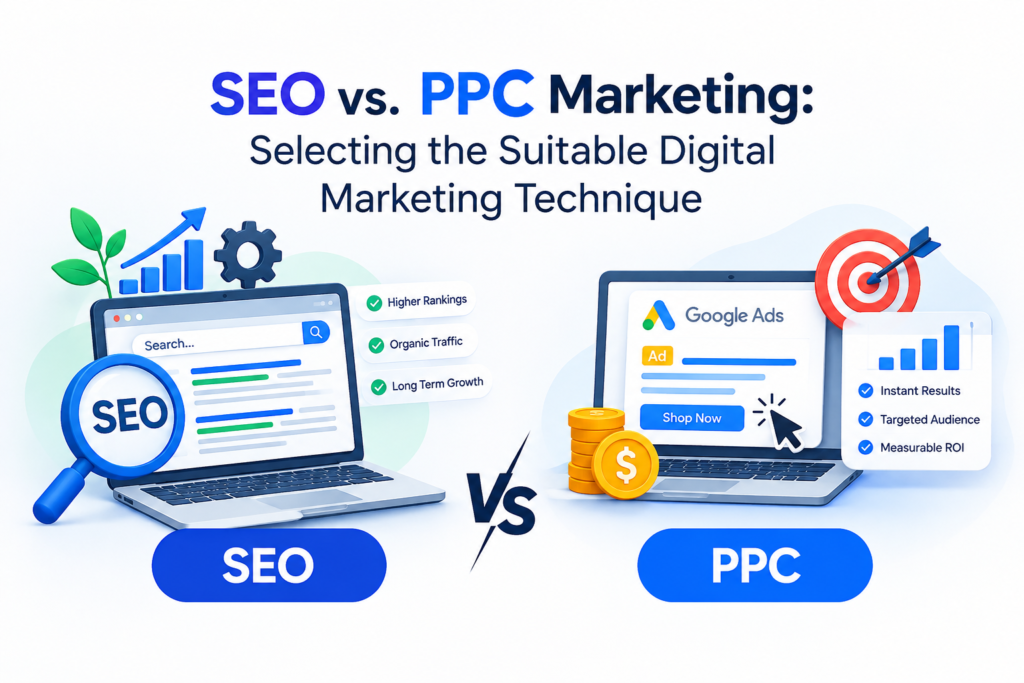
SEO vs.PPC Marketing: Selecting the Suitable Digital Marketing Technique
09,13,2026|by kaja hussain
In the process of creating a marketing strategy and selecting where you are going to allocate your budget, you have likely come across the question that has troubled many marketers since time immemorial: is SEO better than PPC? Both SEO and PPC are incredibly effective tools for increasing your visibility online, but they differ significantly in terms of methodology and the way they are applied, their timing, and the price tag.
This guide explains what SEO and PPC really are, the similarities and differences between these marketing techniques, and how to choose which of the two will be the best choice for your business at the moment.
What Is SEO?
Search engine optimization, abbreviated as SEO, is the process of optimizing your website to achieve higher ranking in the search engines. The following are some factors that form the basis of SEO:
- Researching keywords and creating content
- Optimization through on-page (title, header, description, internal links)
- Improvements in technology (speed, mobile-friendly, crawlable
- Creating good backlinks through other reliable websites
- Consistently writing useful and relevant content
SEO doesn’t have a cost per click for you, but what it does have is a continuous need for time and effort.
What Is PPC?
Pay Per Click (PPC) Advertising is an approach where you get charged whenever there is a click on your advertisement. It normally appears in the format of:
- Google Ads or Bing Ads search ads
- Facebook, Instagram, LinkedIn, or TikTok advertisements on social media
- Display and banner ads through partner networks
- Shopping ads for e-commerce products
PPC is all about visibility. Once your campaign begins, your ad could be at the very top of search engine results, or on someone’s social media page, but once the money stops flowing in, so does the traffic.
Key Differences Between SEO and PPC
1. Speed of Results
- SEO is time consuming. SEO can take several months (generally three to twelve) to improve ranking results, especially when it comes to competitive markets.
- PPC is quick. A PPC ad campaign can be launched today and get clicks and conversions within hours.
2. Cost Structure
- There is no direct cost per click in SEO, although there is some cost in terms of effort and time in creating content and using tools.
- The PPC model does have a direct cost. There is always a cost attached to each click, which depends on how many people are competing for the same keyword.
3. Longevity of Results
- SEO creates value over time. An optimally optimized page continues bringing traffic year after year with little effort.
- PPC can be effective only while you spend money on it. Once you run out of money, it stops delivering anything at all.
4. Trust and Credibility
- SEO results are considered more credible by users, because they don’t consist of paid links.
- PPC ads are easily identifiable as advertisements; there’s even a user tendency to ignore them, although a lot of users will click on them if the offer suits them.
5. Control and Flexibility
- Controlling SEO more precisely is difficult because search engine algorithms keep changing, causing the rankings to become unpredictable.
- In PPC advertising, control is precise as you can tweak the targeting criteria, budget, and messaging right away.
6. Scalability
- SEO grows slowly and builds on itself.
- PPC grows quickly but depends on how much you can pay. Need more traffic? Spend more on your ads!
Pros and Cons at a Glance
SEO Pros:
- Long-term traffic generation
- Free per click
- Increases trust and authority
- High returns for investments made over time
SEO Cons:
- Results come slowly
- Needs constant updating
- Ranking may fluctuate with changes in algorithm
- Breaking into a competitive niche takes a long time
PPC Pros:
- Visibility and traffic immediately
- Targeting made easy (by location, demographics, interests, etc.)
- Measurement and adjustments can be done instantly
- Perfect for time-bound promotion and product launch
PPC Cons:
- Costs cease being effective the minute you stop paying.
- Expensive for competitive sectors
- Management is key to success
- Fatigue may reduce the impact
Which One Is Right for You?
The answer is highly dependent upon your intentions.
Choose SEO if:
- You are creating a brand that will last and you want to grow in a sustainable manner
- You are prepared to wait and see the fruits of your efforts
- You can continue investing in your content and bettering your website.
- You want to lessen the reliance on paid advertising
Choose PPC if:
- You require traffic and leads urgently
- You are rolling out a new product or running a timely promotion
- You want exact control over your audience targeting and messages
- You have a budget you’re happy to spend on a regular basis
Choose both if:
- You want immediate outcomes with future equity.
- You’re coming into a market where you need visibility from all angles.
- You wish to leverage PPC data (such as keywords that convert well) for creating your SEO content strategy.
Indeed, one will find that among some of the most effective digital marketing campaigns, both SEO and PPC do not compete against each other. On the contrary, PPC is utilized as a method for winning fast and gathering information, while SEO will provide the solid foundation, which helps keep down advertising expenses in the future. As your rankings improve via SEO, you can cut back your spending in PPC for some of your keywords.
Final Thoughts
However, there is no absolute right choice when it comes to SEO vs. PPC as this decision ultimately depends on the particular business’s goals, schedule and financial capabilities. In case the results are needed immediately, and there is money to spend, then PPC will be the way to go. When it comes to a long-term plan with the aim to create a stable organic presence, then SEO should be considered.
In case it is possible to conduct both SEO and PPC campaigns at once, then this combination usually yields the best results. The most critical thing to do after making such a choice is to monitor your performance and keep up with changes.